
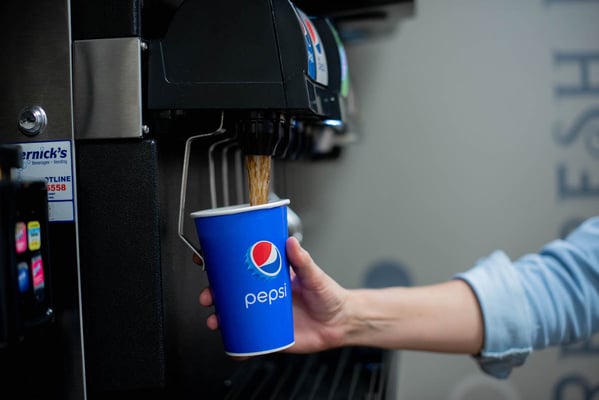
When businesses think about soft drinks, the focus often starts with the menu. What to offer, how many options to include, and how to structure the lineup. But for most on-premise environments, soft drinks are experienced very differently from other beverage categories.
They’re not just selected — they’re served. Most often through fountain systems in the space, integrated into service flow, and designed for consistency and speed.
That’s what makes placement so important. Because guests don’t experience soft drinks as a list of options. They experience them as part of the environment … where the fountain is located, how easy it is to access, and how naturally it fits into their overall experience.
Research shows that convenience and accessibility play a major role in beverage decisions, particularly in on-premise environments. When fountain service is positioned with the guest in mind, it doesn’t just support the experience. It helps drive it.
Where Fountain Service has the Most impact
Not every area within a space performs the same way. Some environments naturally create more opportunities for beverage interaction, especially when fountain service is part of the flow.
- Cafeterias are one of the most consistent examples. Guests move through a defined path, and fountain stations are often placed in a central, easy-to-access location. In these settings, soft drinks become part of the natural progression of the experience, not a separate decision. The Society for Hospitality and Foodservice Management indicates that beverage stations placed within natural traffic flow see higher engagement and usage than those positioned outside the primary path.
- Restaurants and dining areas operate in a similar way. Fountain systems support speed and consistency, allowing staff to serve beverages efficiently while maintaining a familiar experience for guests.
- Lounges, waiting areas, and shared spaces create a different type of opportunity. These environments are less structured, but that does not make beverages less important. In fact, when fountain access is convenient or paired with complementary options, it can enhance the overall experience without requiring additional effort from the guest.
- Event spaces and common areas also benefit from thoughtful placement. Whether in a conference setting, a hospitality environment, or a large gathering space, positioning fountain service where guests naturally gather can increase usage without disrupting the flow.
While packaged beverages play a role in certain environments, especially in grab-and-go or self-serve spaces, fountain service remains the primary driver in many on-premise settings.
Convenience Often Decides Before Preference Does
When it comes to soft drinks, convenience often matters more than anything. Guests may have a general idea of what they want, but their final decision is often shaped by what is easiest in the moment. What they see first. What is closest. What requires the least effort.
That is where placement becomes critical. According to NACS, a large share of beverage purchases are impulse-driven, influenced by visibility and accessibility rather than pre-planned decisions. That behavior applies beyond convenience stores. In cafeterias, dining areas, and self-serve environments, the same principle holds true.
If your soda fountain is easy to find and easy to use, guests are far more likely to include a beverage with their purchase.
How Placement Shapes Flow, Speed, and Satisfaction
Soft drink placement doesn’t just influence what guests choose. It can also impact how smoothly everything else works, too. When fountain stations are positioned within the natural flow of traffic, they support faster decision-making and help keep lines moving. Guests can move from food selection to beverage to checkout without interruption.
When placement is less intuitive, it can create friction. Guests may skip a beverage entirely or hesitate if it feels out of the way.
In staffed environments, placement directly affects efficiency. Fountain systems that are easy for staff to access help reduce service time and improve consistency. In self-serve setups, clear placement allows guests to move independently and confidently through the space.
These small decisions shape the overall experience. Over time, they influence both satisfaction and performance.
Where Ready-to-Drink Beverages Play a Supporting Role
While soda fountain services make up most soft drink programs, ready-to-drink (RTD) beverages still play an important supporting role in the right environments.
Self-serve areas, micro markets, and grab-and-go spaces rely more heavily on bottled and canned options. These formats allow guests to browse quickly and make independent decisions, especially in high-traffic or time-sensitive situations.
In these spaces, packaged beverages expand variety and complement fountain offerings. A cooler stocked with recognizable options gives guests additional choices without changing the core setup.
This combination works well because each format serves a different purpose. Fountain supports consistency and volume, while packaged supports flexibility and visibility.
The Best Beverage Programs Are Built Into Your Space
The most effective soft drink programs do not feel separate from the environment. They feel like part of it. In many cases, the soda machine isn’t just part of the beverage program – it’s part of the infrastructure. It supports how guests move, how staff serve, and how the overall experience comes together.
That might look like a fountain machine placed along a natural traffic path, a beverage station positioned to reduce bottlenecks, or a layout that makes adding a drink feel like the easiest part of the process. Industry data shows that beverages remain among the most consistent contributors to overall sales, especially when they are easy to access and integrated into the guest experience.
When placement aligns with how people actually move through a space, everything becomes simpler. Guests make decisions more quickly. Staff operate more efficiently. And beverages become a seamless part of the experience.
FAQ: Soft Drinks in Foodservice Environments
- Why does fountain placement matter in foodservice?
Placement affects visibility, convenience, and the likelihood that guests will choose a beverage, especially in high-traffic environments. - Where should fountain beverages be located for the best performance?
Fountain systems perform best when placed within natural traffic flow, near food service areas, or in easily accessible self-serve locations. - Do packaged beverages replace fountain service?
Not necessarily. Packaged beverages typically support fountain programs by adding variety in grab-and-go or self-serve environments. - How can businesses improve beverage performance without changing products?
Improving placement, visibility, and access can increase beverage selection without adding new items.
When Placement Is Right, Everything Performs Better
Fountain soft drinks have always been a core part of the foodservice experience. But where they are placed and how easily guests can access them play a big role, too.
When fountain service is positioned with your guest in mind, it becomes more visible, more convenient, and more likely to be chosen. And when that happens consistently, it does more than improve beverage sales. It strengthens the overall experience.
In the end, it is not just about what you offer. It is about how it fits into the space your guests move through every day.

